
Market Analytics Web Application — Seer Analytics
An original Flask application bringing PDF market analysis into interactive maps, dashboards, and Primary Market Area analytics.
- Original Application
- Flask
- Application
- Primary Market Area Analytics
- Spatial Data
- PostgreSQL / PostGIS
- python
- flask
- sqlalchemy
- postgis
- postgresql
- catchment-analysis
Evidence
Overview
Seer Analytics, a Florida-based US company, had an established PDF market-analysis product. Working through Mammoth Geospatial, I helped develop an interactive application that brought market-area analysis into web maps and dashboards.
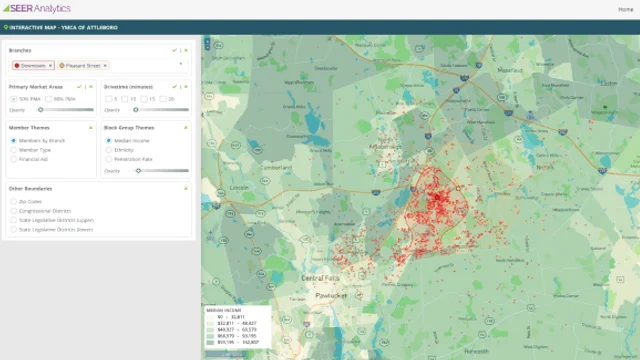
The application was known as PMA (Primary Market Area). The retained YMCA of Attleboro screenshot shows facility catchments, member locations, and demographic block groups in the United States. Users could explore the relationship between a facility’s market area, its members, and the surrounding population.
Mammoth records the overall project period as 2016–2020. This is the public project timeline; my exact contribution dates within that period are not separately documented here. My broader Mammoth engagement ran from 2016 to 2023.
Original Application & Data Workflows
The original application was built entirely in Flask. My work focused on application services and spatial data workflows for market-area and facility catchment analysis.
The project used SQLAlchemy with PostgreSQL/PostGIS for relational and spatial data, and GeoServer for spatial data services. These are also recorded in Mammoth’s published project stack. The YMCA interface illustrates the analytical context: drive-time catchments, member locations, and demographic block groups.
Later Refactoring & Published Stack
Mammoth’s public case study lists VueJS, OpenLayers, D3, Flask, SQLAlchemy, PostGIS, and GeoServer across the project’s lifecycle. It also records a later refactor as the application’s purpose and audience broadened.
That lifecycle technology list does not establish when each frontend technology was introduced or which parts I worked on. The original implementation described here remains the Flask application; the later refactor is recorded as project history without assigning its frontend work to my contribution.