Grip Sport Australia: High-Performance Website Rebuild
Migrating Australia's national grip strength athletics platform from a legacy GoDaddy site builder to a component-driven Astro static site, improving page speed, mobile navigation, and competition discovery.
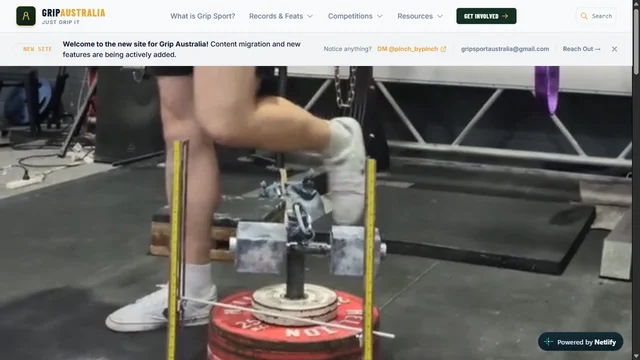
- Platform Migration
- GoDaddy to Astro SSG
- Performance
- 95 / 100 Desktop
- Client Runtime
- Zero-JS Static HTML
- Layout
- Mobile-First Responsive
- astro
- typescript
- tailwind-css
- static-site
- seo
- responsive-design
Evidence
Overview
Grip Sport Australia (gripaustralia.com) is the community and resource hub for grip strength athletics in Australia, operating under Grip Sport International (GSI) contest standards. The organisation supports competitors, training gyms, meet organisers, and record tracking across four core contest disciplines: crushing grippers, pinch blocks, thick rolling handles, and vertical lift implements.
The original web presence operated on GoDaddy’s hosted site builder. Over time, that legacy setup accumulated several practical limitations: slow initial page loads caused by unoptimised third-party scripts, rigid layouts that made scorecards and record tables awkward to browse on mobile devices during gym meets, and high friction when updating competition results, event calendars, and equipment guides.
The objective was to migrate the platform off GoDaddy onto a lightweight static architecture built with Astro and Tailwind CSS, deployed to an edge CDN, delivering fast load times, clear mobile navigation, and structured content models for competitions and records.
Architecture & Implementation
1. Site-Builder Migration & Content Modelling
The legacy GoDaddy site stored competition announcements, rules, records, and contact channels across disconnected page-builder blocks.
- Audited and catalogued existing assets: competition calendars, historical championship results (2024–2026), Australian grip feats (such as Thomas Inch dumbbell and Blob lifts), and local event listings.
- Structured content into clean data models and modular pages, making it straightforward to add new tournament results and update record tables without modifying presentation layouts.
- Preserved legacy URLs with clean redirects to maintain inbound community links from strength forums and social media.
2. Static Site Architecture (Astro & Tailwind CSS)
Selected Astro as the core framework to generate lightweight static pages without client-side runtime overhead:
- Zero Client JavaScript by Default: Rendered pure static HTML and scoped CSS at build time. Avoided client-side JavaScript hydration for content pages, keeping initial load times immediate even on cellular connections at gym venues.
- Production Performance Baseline: A production Lighthouse audit (September 2026) verified 95/100 Desktop Performance, 95/100 Accessibility, 78/100 Best Practices, and 100/100 SEO. Mobile Performance reached 62/100 due to third-party embedded video and web fonts.
- Dual-Theme Token System: Built an accessible theme switcher supporting high-contrast “Calibrated Minimalism” (light mode) and “Outback Ochre” (dark mode), controlled via an inline anti-FOUC script and interactive header toggle.
- Component-Driven Layouts: Designed reusable components for competition scorecards, equipment guides, host venue profiles (such as Ultra Fitness and Strength in Canberra), and service listings.
3. Mobile Navigation & Competition UX
Athletes and judges frequently access the site from mobile devices during competitions to verify implement rules, weight categories, and historical records.
- Built a streamlined mobile navigation drawer providing direct paths to rules, upcoming meets, and records.
- Formatted scoresheets, record lists, and equipment directories with responsive tables and clean typography for quick scanning in high-glare gym environments.
- Integrated clear pathways for community engagement, including event registration links (e.g. King Kong Grip Challenge), Artie’s Grip Gym gripper calibration service (RGC ratings), and contact channels.
4. Edge Deployment & Structured Metadata
- Configured automated deployment to an edge CDN with pre-rendered HTML and immutable caching headers for static assets.
- Implemented semantic HTML landmarks, Open Graph cards, and structured JSON-LD schemas to support search visibility for Australian strength sports, grip contests, and equipment calibration queries.